
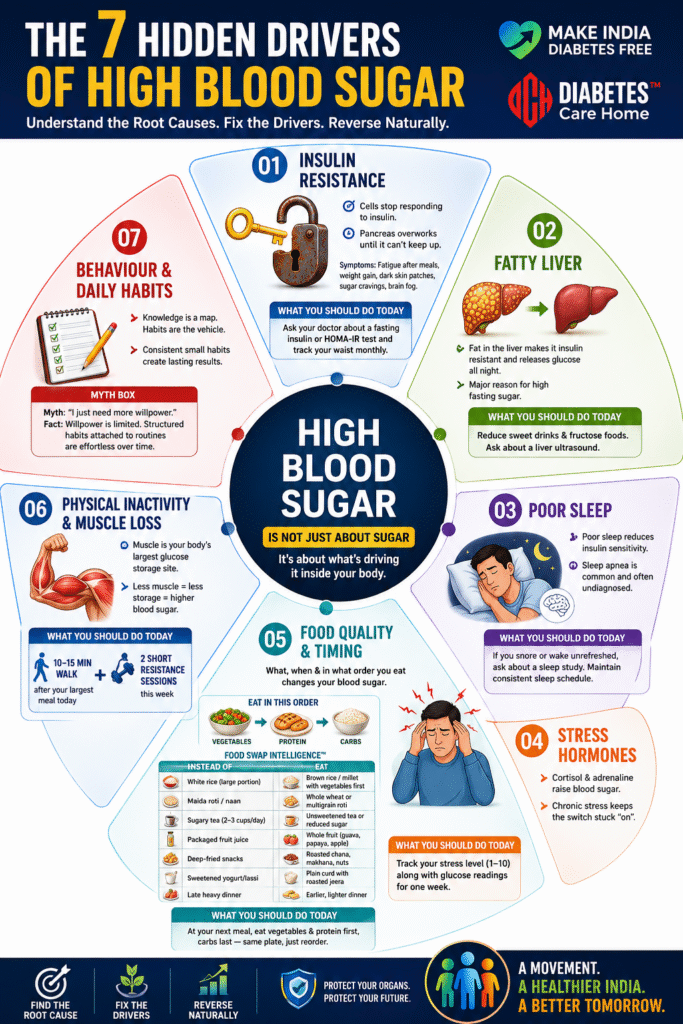
The 7 Hidden Drivers of High Blood Sugar
Executive Summary
Most people with high blood sugar are told to eat less sugar and take their medicine. Millions do exactly that — and their numbers barely move. This isn’t a discipline problem. It’s an information gap.
High blood sugar is usually the visible symptom of seven underlying drivers: insulin resistance, fatty liver, poor sleep, stress hormones, food quality and timing, muscle loss, and daily habits. Medicines manage the symptom. Addressing the drivers is what gives your body — and your doctor — a real chance to bring numbers down sustainably, and in some cases work toward remission.
This guide explains each driver in plain language, shows you the Clinical Intelligence Frameworks™ used to identify which drivers apply to you specifically, and gives you a clear next step — without asking you to abandon your doctor or your medication.
Key Takeaways
- High blood sugar is a symptom of underlying drivers, not a disease in itself.
- Medicines control symptoms; they rarely fix the root cause.
- Insulin resistance can affect lean people too — especially South Asians.
- Fatty liver is a leading, silent cause of stubborn fasting blood sugar.
- One bad night’s sleep can measurably worsen tomorrow’s blood sugar.
- Chronic stress hormones raise blood sugar independently of diet.
- How and when you eat matters as much as what you eat.
- Muscle is your body’s largest glucose storage site — and it shrinks with age and inactivity.
- Knowledge alone rarely changes behaviour; structured habits do.
- The right first step is identifying which drivers apply to you — not applying generic advice to everyone.
Who Should Read This
Patients with diabetes whose numbers aren’t improving despite medication ·
Prediabetics wanting to prevent progression ·
Doctors & dietitians seeking a patient-friendly explanatory resource ·
Hospitals exploring structured diabetes care models ·
Families supporting a loved one with diabetes
Why This Matters
Diabetes is one of the fastest-growing chronic conditions in India, and a large share of patients on treatment still do not reach their target blood sugar levels. The usual explanation — “poor compliance” — is often wrong or incomplete. In reality, most standard advice addresses only one or two of the seven drivers below, leaving the rest unaddressed and the numbers stubbornly high.
What You’ll Learn
- The 7 hidden drivers behind high blood sugar — and how to spot which ones apply to you
- Why medicines alone often plateau
- How diabetes silently progresses over 15 years, and which organs are affected first
- The Clinical Intelligence Frameworks™ used to personalise a plan
- A realistic, non-guaranteed patient journey
- Your next step, if you want a personalised review
Table of Contents
- The Story That Changes Everything
- The Problem: Diabetes Is Not “Just a Sugar Problem”
- Why Medicines Alone Often Fail
- The 15-Year Timeline: How Diabetes Actually Develops
- Which Organ Gets Affected First?
- Warning Signs: Early, Middle, Late
- The 7 Hidden Drivers of High Blood Sugar
- Introducing Our Clinical Intelligence Frameworks™
- The 7 Organ Protection Framework™
- A Real Patient Journey
- Traditional Advice vs. Precision Diabetes
- Top 5 Questions From the High Blood Sugar Audit
- The 30-Day Reset: Framework Overview
- 10 Questions People Ask Us Most
- Continue Your Journey
- A Note on Medical Safety
The Story That Changes Everything
Ramesh Ji is 52. He takes his diabetes medicines every day, exactly as prescribed. He has cut sugar from his tea. He even refused the mithai at his own daughter’s engagement.
Six months later, his fasting blood sugar is still 162. His HbA1c has barely moved. His doctor increases the dose again.
Ramesh Ji is not lazy, and he is not “not trying hard enough.” He is a man who has been told half the story.
Most of us were taught that diabetes is a sugar problem: eat less sugar, take your tablets, numbers fall. For some people, that’s roughly true. For millions of others — quite possibly including you — it is dangerously incomplete.
What You Should Do Today
Before changing anything, get clear on your pattern: track your fasting and post-meal readings separately for 3–5 days. This single habit is the first step of the Root Cause Intelligence™ process below.
To get Regular updates on Diabetes Join India’s Free Diabetes Healing Hub Community under make India Diabetes Free Mission by Dr D K Rai
- The Problem: Diabetes Is Not “Just a Sugar Problem”

5_Pillars of Diabetes
High blood sugar is usually a symptom, not the disease itself. Type 2 diabetes is better understood as a whole-body energy storage and signalling disorder. Sugar rises because something upstream has gone wrong — insulin resistance, a fatty liver overproducing sugar, or stress hormones keeping the liver switched on around the clock.
Treating only the number without treating the driver is like mopping the floor under a leaking pipe without turning off the tap.
For more details on Diabetes is Not a Sugar Problem only
Myth Box
Myth: “Diabetes is caused by eating too much sugar.” Fact: Diabetes is primarily driven by insulin resistance, genetics, liver fat, and lifestyle factors. Sugar intake is one piece of a much larger picture.
- Why Medicines Alone Often Fail
Diabetes medications are genuinely valuable, and nothing here suggests stopping or reducing them without your doctor’s guidance. But it helps to understand what they do — and don’t do.
| Medicine Class | What It Does | What It Doesn’t Do |
| Metformin | Reduces liver sugar release | Doesn’t reverse fatty liver or insulin resistance |
| Sulfonylureas | Pushes pancreas to release more insulin | Doesn’t fix why cells resist insulin |
| SGLT2 inhibitors | Flushes excess sugar via urine | Doesn’t address root metabolic drivers |
| Insulin | Directly supplies the hormone | Doesn’t rebuild muscle, fix sleep, or lower stress hormones |
Doctor’s Note
Medicines control the symptom. Addressing the seven drivers below is what gives your body a genuine chance to need less medicine over time — always in coordination with your treating doctor.
Research Box
Diabetes remission is now formally recognised by bodies including the ADA and Diabetes UK as an achievable outcome for a meaningful subset of patients — typically earlier in the disease course, with significant, sustained metabolic improvement under medical supervision. It is not guaranteed, and it is not the same as cure.
- The 15-Year Timeline: How Diabetes Actually Develops
Diabetes Disease Intelligence Map
Diabetes rarely appears overnight. It typically builds silently over a decade or more before diagnosis:
| Stage | Approximate Timing | What’s Happening Internally | What’s Visible |
| Stage 1 — Early Resistance | Years 1–5 | Cells gradually become less responsive to insulin | Usually nothing; maybe mild weight gain around the waist |
| Stage 2 — Compensation | Years 5–8 | Pancreas overproduces insulin to compensate | Fatigue after meals, cravings, occasional fasting sugar creep |
| Stage 3 — Prediabetes | Years 8–10 | Fasting/post-meal sugar rises above normal | Often still asymptomatic; typically caught on routine testing |
| Stage 4 — Diagnosis | Years 10–12 | Pancreas can no longer fully compensate | Fatigue, thirst, frequent urination, blurred vision |
| Stage 5 — Progression | Years 12–15+ | Organ systems begin showing measurable strain if unaddressed | Early signs in eyes, kidneys, nerves, or heart may emerge |
Myth Box
Myth: “I was diagnosed suddenly, so it must have started recently.” Fact: For most people, the underlying process was building for years before a diagnosis made it visible.
- Which Organ Gets Affected First?

7_Organ_Protection_Framework_
Not all organs are affected at the same time or rate. In general, the sequence tends to follow blood vessel size and sensitivity:
- Small blood vessels first — eyes, kidneys, and peripheral nerves are typically the earliest to show measurable changes, often before symptoms appear.
- Liver changes — frequently develop in parallel, often before diagnosis, and are a major hidden driver rather than a downstream complication.
- Large blood vessels later — heart and brain-related vascular risk tends to accumulate over a longer horizon, compounded by blood pressure and cholesterol.
- Feet — affected by a combination of nerve and circulation changes, usually becoming clinically relevant in later, poorly-controlled stages.
This is precisely why the 7 Organ Protection Framework™ later in this article recommends annual screening from diagnosis (or even from prediabetes) — not screening that starts only after symptoms appear.
<a id=”warning-signs”></a>
- Warning Signs: Early, Middle, Late
| Stage | Signs to Watch For |
| Early | Fatigue after meals, sugar cravings, difficulty losing weight, waist circumference creeping up, mild post-meal sleepiness |
| Middle | Fasting sugar consistently elevated, HbA1c above target despite medication, snoring/unrefreshing sleep, visible abdominal fat, cravings worsening with stress |
| Late | Tingling/numbness in feet, blurred vision, foamy urine, slow-healing wounds, breathlessness on exertion |
What You Should Do Today
If you recognise “Middle” or “Late” signs, don’t wait for your next scheduled visit — bring this list to your doctor proactively.
- The 7 Hidden Drivers of High Blood Sugar
Driver 1: Insulin Resistance
Insulin is the key that unlocks your cells so glucose can move out of the blood. In insulin resistance, the lock becomes rusty — cells stop responding properly, and the pancreas compensates by producing more and more insulin until it can’t keep up.
Simple analogy: Imagine shouting a message in a room full of people wearing noise-cancelling headphones. You shout louder and louder just to be heard — until your voice gives out.
Symptoms: Fatigue after meals, difficulty losing weight, dark velvety skin patches (acanthosis nigricans), sugar cravings, brain fog.
⚖️ Traditional Advice → Precision Diabetes
Only Treat Sugar → Treat Root Cause Generic advice says “eat less sugar.” A root-cause approach asks why your cells stopped responding to insulin in the first place — and addresses that instead.
Common Mistake
Focusing only on “sugar” foods while ignoring refined carbohydrates, sedentary time, and abdominal fat — all of which drive resistance independently of dessert.
What You Should Do Today
Ask your doctor about a fasting insulin or HOMA-IR test — not just fasting glucose — and start tracking your waist circumference monthly.
Driver 2: Fatty Liver
Your liver is your body’s glucose warehouse. When fat accumulates inside liver cells (non-alcoholic fatty liver disease / MASLD), the liver becomes insulin resistant in its own right and releases glucose even when it isn’t needed — especially overnight. This is a major, under-discussed reason for stubbornly high fasting blood sugar.
Simple analogy: A lean liver only ships out sugar when the body radios in a request. A fatty liver becomes a confused warehouse manager who keeps shipping sugar out all night — requested or not.
Clinical Pearl
If your fasting sugar runs high but your post-meal readings look reasonable, ask your doctor about a liver ultrasound and liver enzyme (ALT/AST) test — this pattern often points toward the liver, not the dinner plate.
Myth Box
Myth: “Fatty liver only happens if you drink alcohol.” Fact: Non-alcoholic fatty liver is extremely common in people who don’t drink at all, and is closely tied to diet quality and abdominal fat.
What You Should Do Today
Reduce sweetened beverages and fructose-heavy processed foods — a major driver of liver fat — and ask about a liver ultrasound if this pattern fits you.
Driver 3: Poor Sleep
A single night of poor sleep can measurably reduce insulin sensitivity the next day. Chronic poor sleep — including undiagnosed sleep apnea, common in diabetes — keeps the body in a low-grade stress state that raises blood sugar around the clock.
Symptoms: Waking unrefreshed, loud snoring, witnessed breathing pauses, morning headaches, unexplained high fasting sugar despite a controlled dinner.
Research Box
Obstructive sleep apnea is present in a substantial proportion of people with type 2 diabetes, and frequently goes undiagnosed because patients assume tiredness is simply “part of having diabetes.”
What You Should Do Today
If you snore or wake unrefreshed, ask your doctor whether a sleep study is appropriate — and set a consistent sleep/wake time this week regardless.
Driver 4: Stress Hormones
Cortisol and adrenaline deliberately raise blood sugar — a survival mechanism from when stress meant physical danger requiring fuel. Chronic modern stress keeps this switch stuck “on.”
Simple analogy: Cortisol is an accelerator pedal your body presses automatically under threat. If your foot never comes off — because the “threat” is ongoing work or family stress — the engine keeps racing even while the car is parked.
⚖️ Traditional Advice → Precision Diabetes
Generic Willpower → Behaviour Intelligence™ “Just manage your stress” rarely works. A structured approach identifies your specific stress triggers and builds a daily reset practice around them.
Common Mistake
Dismissing stress as unmeasurable and therefore leaving it out of the diabetes plan entirely.
What You Should Do Today
Track your stress level (1–10) alongside your glucose readings for one week — most patients are surprised by the pattern.
Driver 5: Food Quality & Timing
It’s not just what you eat — when and in what order changes how high blood sugar rises and how long it stays elevated. Eating vegetables and protein before carbohydrates has been shown to blunt the size of the glucose spike from the same meal.
Simple analogy: Pouring sugar syrup straight into a glass makes it overflow fast. Pouring it through a sieve packed with fibre (vegetables, protein) slows the flow to a manageable trickle.
Food Swap Intelligence™
| Instead of | Eat | Expected Benefit |
| White rice (large portion) | Brown rice / millet with vegetables first | Slower glucose rise, more fibre |
| Maida roti / naan | Whole wheat or multigrain roti | Lower glycaemic load |
| Sugary tea (2–3 cups/day) | Unsweetened tea or reduced sugar | Fewer spikes across the day |
| Packaged fruit juice | Whole fruit (guava, papaya, apple) | Fibre slows sugar absorption |
| Deep-fried snacks | Roasted chana, makhana, nuts | Less refined fat/carb load |
| Sweetened yogurt/lassi | Plain curd with roasted jeera | Protein without added sugar |
| Late heavy dinner | Earlier, lighter dinner | Lower overnight/fasting glucose |
What You Should Do Today
At your very next meal, eat vegetables and protein first, carbs last — same plate, same portions, just reordered.
Driver 6: Physical Inactivity & Muscle Loss
Muscle is your body’s largest glucose storage site. Every kilogram of muscle lost — a natural process that accelerates after 40 without training — is glucose storage capacity lost too.
Simple analogy: Muscle is storage shelving in a warehouse. Fewer shelves means incoming stock (glucose) has nowhere to go and piles up in the aisles — your bloodstream.
Clinical Pearl
Walking and resistance training work through complementary mechanisms. Walking after meals blunts the immediate spike; resistance training builds the long-term storage capacity that keeps future spikes smaller.
What You Should Do Today
Add a 10–15 minute walk after your largest meal today, and pencil in two short resistance sessions this week.
Driver 7: Behaviour & Daily Habits
You can know everything in this guide and still not change your numbers, because knowing and doing consistently run through different parts of the brain.
Simple analogy: Knowledge is a map. Habits are the vehicle. A perfect map is useless if you never get in the car.
Myth Box
Myth: “I just need more willpower.” Fact: Willpower is a limited, fatigue-prone resource. Structured habits — attached to existing routines — require far less mental energy to sustain for months and years.
What You Should Do Today
Pick one tiny habit and attach it to something you already do daily (e.g., “walk immediately after switching off the TV”). Don’t try to change five things at once.
- Introducing Our Clinical Intelligence Frameworks™
Behind this article is a structured clinical methodology, built from 20+ years of hospital and patient-facing practice, designed to identify which of the seven drivers matter most for your specific case — because the right first step is different for a lean, stressed insomniac than for a sedentary patient with fatty liver.
REST Method™ — our four-pillar way to organise everything in this guide:
| Pillar | Focus |
| R — Root Cause Intelligence™ | Identifying why your sugar is high, not just that it’s high |
| E — Eating Strategy | Food quality, sequencing, and timing (Food Swap Intelligence™) |
| S — Strength & Sleep | Building glucose storage capacity and recovery |
| T — Tracking & Tiny Habits | Behaviour Intelligence™ — sustainable, structured change |
Root Cause Intelligence™ analyses your fasting-vs-post-meal glucose pattern, waist circumference, sleep quality, stress load, activity level, and habit history to identify a personalised priority order — rather than generic “eat less, move more” advice.
Behaviour Intelligence™ applies structured habit-change principles — tiny habits, environmental triggers, identity-based framing, and habit stacking — specifically to diabetes self-care.
CGM Precision Intelligence™ uses Continuous Glucose Monitoring data to show how your body specifically responds to meals, stress, sleep, and activity — because two people eating an identical meal can have very different glucose responses.
Two additional frameworks in our clinical system — the Diabetes Organ Risk Index and the Diabetes Transformation Score™ — go deeper into organ-level risk tracking and comprehensive monthly progress measurement. We cover these in dedicated articles: “The Hidden Organ Damage Diabetes Causes” and “Why HbA1c Alone Cannot Measure Your Diabetes Progress.”
- The 7 Organ Protection Framework™
7_Organ_Protection_Framework_
| Organ | Why Diabetes Damages It | Early Warning Signs | Key Tests | Protection Tips |
| Heart | Accelerated artery damage and plaque buildup | Breathlessness, chest discomfort, fatigue on exertion | Lipid profile, ECG, BP | Control BP/cholesterol, quit smoking, stay active |
| Kidneys | Damage to filtering units over time | Foamy urine, ankle swelling, fatigue | Urine microalbumin, creatinine, eGFR | Control BP, annual screening |
| Eyes | Damage to small retinal blood vessels | Blurred vision, floaters, poor night vision | Dilated retinal exam (annual) | Tight glucose/BP control |
| Brain | Linked to accelerated cognitive changes over years | Memory lapses, concentration issues | Cognitive screening if symptomatic | Manage vascular risk, sleep, activity |
| Liver | Fat accumulation worsens insulin resistance | Usually silent; mild fatigue | Ultrasound, liver enzymes | Weight management, reduce refined carbs |
| Feet | Reduced circulation/sensation raises injury risk | Numbness, tingling, slow-healing cuts | Annual foot exam | Daily inspection, proper footwear |
| Nerves | Peripheral nerve fibre damage | Tingling, burning, numbness | Clinical neuropathy exam | Glucose control, B12 check |
- A Real Patient Journey
The following is a fictional, illustrative composite created for educational purposes. It does not represent a real patient, and outcomes are not guaranteed or typical — always consult your treating doctor.
| Patient A — Medicine Only | Patient B — Medicine + Root Cause Intelligence™ | |
| Approach | Medication, generic diet advice | Same medication + sleep, stress, sequencing, resistance training addressed |
| Sleep | Unaddressed; undiagnosed mild apnea | Identified and treated |
| Stress | Not tracked | Tracked and managed with daily reset practice |
| Activity | Occasional walking | Post-meal walks + 2x/week resistance training |
| Outcome pattern observed | HbA1c plateaued despite dose increases | HbA1c trended down alongside unchanged medication (illustrative; individual results vary) |
“Sunita” 47, was diagnosed with an HbA1c of 8.4%. A year of medication-only management brought only modest improvement, and she began to believe “my body just doesn’t respond to treatment.” A Root Cause Intelligence™ review revealed undiagnosed sleep issues, high stress, and low muscle mass as her dominant drivers — not diet alone. Addressing these, alongside her unchanged medication under her doctor’s guidance, was followed by a gradual improvement in her readings over the following months.
This composite journey illustrates patterns seen in structured, doctor-supervised programs. No specific outcome, timeline, or level of improvement is guaranteed for any individual.
For more details of Diabetes Treatment -watch This Video-
- Traditional Advice vs. Precision Diabetes
| Traditional Advice | Precision Diabetes |
| Only Treat Sugar | Treat Root Cause |
| One Diet for Everyone | Personalised Diet Based on Your Drivers |
| Generic Walking Advice | CGM-Informed Activity Timing |
| “Try harder” | Structured Habit Design |
| React After Complications | Annual Organ Protection Screening From Day One |
- Top 5 Questions From the High Blood Sugar Audit
A quick self-check — rate each Yes / No / Sometimes:
- Do I eat vegetables/protein before carbs at most meals?
- Do I walk for 10+ minutes after most meals?
- Do I sleep 7+ hours with a consistent schedule most nights?
- Do I have a daily stress-reset practice?
- Have I had a liver ultrasound or fasting insulin test if my numbers stay high despite good post-meal readings?
If you answered “No” to two or more, structured guidance will likely help more than trying harder on your own.
If you want to check your Mistakes in diabetes management Check it free
- The 30-Day Reset: Framework Overview
Our structured reset follows four phases:
- Week 1 — Awareness: Track your current patterns without changing anything yet.
- Week 2 — Foundation: Introduce meal sequencing and a daily post-meal walk.
- Week 3 — Build: Add resistance training and a daily stress-reset practice.
- Week 4 — Consolidate: Review what’s working and lock in your highest-impact habit.
Always begin any new plan in consultation with your treating doctor, especially if you take glucose-lowering medication.
- 10 Questions People Ask Us Most
- Why is my blood sugar still high even though I take my medicine regularly? Medicines address one part of the picture; underlying drivers like insulin resistance, fatty liver, sleep, and stress often need attention alongside medication.
- Can type 2 diabetes really be reversed? For some patients, particularly earlier in the disease course, significant sustained lifestyle change can lead to remission — not guaranteed for everyone, and always under medical supervision.
- Why does my fasting sugar stay high despite a light dinner? This pattern often points toward fatty liver or overnight stress-hormone activity rather than the dinner itself.
- Does poor sleep really raise blood sugar? Yes — even a single night of poor sleep can measurably reduce next-day insulin sensitivity.
- Can lean people have insulin resistance? Yes, especially South Asians, who often carry more internal (visceral) fat at lower body weights.
- Does eating order really matter? Yes — eating vegetables/protein before carbohydrates has been shown to blunt post-meal glucose spikes.
- Is resistance training safe for diabetics? Generally yes, with medical guidance, and it offers benefits distinct from walking alone.
- What is Continuous Glucose Monitoring (CGM) used for? It shows how your individual body responds to specific meals, stress, sleep, and activity in near real time.
- Should I stop my medicines if my sugar improves? Never, without your doctor’s explicit guidance.
- Where can I get a personalised assessment based on these frameworks? See “Continue Your Journey” below.
For Gestational Diabetes watch this Video-
- Continue Your Journey
Understanding diabetes is the first step. Understanding your diabetes is the next.
Read these topics also
Diabetes Is More Than a Sugar Problem | The Complete Organ Protection Guide Volume 1
The Gut Microbiome and Its Role in Diabetes Reversal: Emerging Research and Practical Tips
If you’d like a structured review of your personal risk factors, discuss this article with your healthcare professional — or consider a personalised metabolic assessment that explores factors such as lifestyle, organ health, glucose patterns, and individual goals. Call 9773935777 or Visit Diabetes Care Home, Plot no 30 Shakti Khand -4, Indirapuram, Ghaziabad, UP
To get Regular updates on Diabetes Join India’s Free Diabetes Healing Hub Community under make India Diabetes Free Mission by Dr D K Rai
- A Note on Medical Safety
This article is for educational purposes and does not constitute individual medical advice. Diabetes management must always be personalised. Never stop, reduce, or change any medication — including insulin — without first consulting your treating doctor. If you experience symptoms of low blood sugar (shakiness, sweating, confusion, rapid heartbeat), treat promptly per your doctor’s guidance and seek medical attention if severe.
© Diabetes Care Home™ | Make India Diabetes Free Mission. Educational content only — not a substitute for professional medical advice, diagnosis, or treatment. REST Method™, Root Cause Intelligence™, Food Swap Intelligence™, Behaviour Intelligence™, CGM Precision Intelligence™, 7 Organ Protection Framework™, and Diabetes Intelligence Letter™ are proprietary frameworks of Diabetes Care Home™.

