

Clinically guided by Dr. D.K. Rai (Diabetologist), Diabetes Care Home, Indirapuram, Ghaziabad — part of the Make India Diabetes Free (MIDF) Mission.
⭐ ~30-minute evidence-informed read Last updated: 01-08-2026 ⚕️ Medically reviewed Free checklists inside
Medical disclaimer: This article is for education, not diagnosis or treatment. Never start, stop, or change any medicine or supplement without talking to your treating doctor first. Reference ranges in this guide are general and commonly used — your own targets should always be set with your doctor.
The Scale of the Problem
[India’s Diabetes Burden]
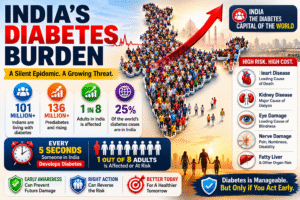
According to the International Diabetes Federation’s 11th edition Diabetes Atlas (2025), India had an estimated 89.8 million adults living with diabetes in 2024, with age-standardized prevalence at 10.5%, projected to rise to 12.8% by 2050 [1]. India accounts for roughly 1 in every 7 adults with diabetes worldwide, ranking second globally in absolute numbers [1].
What makes this more urgent than the headline number: regional research on South Asia found that in India’s largest epidemiological diabetes study, fewer than 1 in 4 people on regular treatment had actually achieved glycaemic control (defined as HbA1c under 7%) — and separately, nearly half of adults with diabetes in South Asia are estimated to be undiagnosed altogether [5].
What this means for you: even among people who are diagnosed and on treatment, most are not achieving control by the standard benchmark. This isn’t a motivation problem at population scale — it’s a signal that the approach needs to go beyond “take your medicine and cut sugar.”
Who Should Read This
✓ People with prediabetes
✓ People with type 2 diabetes
✓ Family members supporting someone with diabetes
✓ Doctors and dietitians looking for a patient-friendly explainer
✓ Hospital and clinic leaders building patient education content
✓ Anyone who wants to understand — and reduce — their risk of diabetes complications before symptoms appear
What You’ll Learn
✓ Why diabetes is a whole-body metabolic condition, not just a sugar number
✓ Why HbA1c only tells part of the story
✓ The hidden root causes behind poor control
✓ How diabetes can silently affect seven major organs
✓ Practical, India-specific food swaps
✓ The REST Method™ for organizing day-to-day management
✓ How CGM data can personalize decisions
✓ Exactly what to ask your doctor at your next visit
Table of Contents
- Two Stories From the Same Clinic
- The Biggest Myth: “Diabetes Is Just a Sugar Problem”
- The Metabolic Disease Model
- ⚠️ The Hidden Root Causes Behind Poor Control
- Why HbA1c Only Tells Part of the Story
- Where Do You Stand? Reference Ranges at a Glance
- The Silent Journey: From Prediabetes to Complications
- ❤️ The 7 Organ Protection Framework™
- DORI™ — The Diabetes Organ Risk Index
- The REST Method™
- Food Swap Intelligence™
- CGM Precision Intelligence™
- Behaviour Intelligence™
- ⚖️ Traditional Approach vs. Diabetes Intelligence™ Approach
- ❓ Myth vs. Fact
- ✅ The 30-Day Diabetes Reset Checklist
- ⚕️ Your Next Doctor Visit — What to Ask
- Frequently Asked Questions
- References
- Continue Your Diabetes Intelligence™ Journey
- Two Stories From the Same Clinic
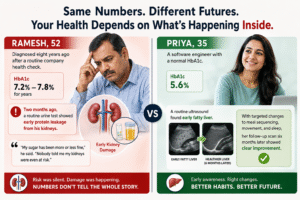
2 Diabetes PatientsRamesh, 52. Diagnosed eight years ago after a routine company health check. HbA1c hovered between 7.2% and 7.8% for years. Two months ago, a routine urine test showed early protein leakage from his kidneys. “My sugar has been more or less fine,” he said. “Nobody told me my kidneys were even at risk.”
Priya, 35. A software engineer with a normal HbA1c of 5.6%. A routine ultrasound found early fatty liver. With targeted changes to meal sequencing, movement, and sleep, her follow-up scan six months later showed clear improvement.
“Blood sugar is the smoke. Metabolic dysfunction is the fire.”
Ramesh and Priya’s reports look opposite. They share one lesson: a single number, checked occasionally, cannot tell you what’s happening inside your body.
- The Biggest Myth: “Diabetes Is Just a Sugar Problem”
“As long as my sugar report is fine, I’m fine.” Two people can have an identical HbA1c and be in very different states of organ health — as Ramesh and Priya’s stories show.
Diabetes
↓
Insulin Resistance
↓
Fatty Liver
↓
Chronic Inflammation
↓
Persistently High Blood Sugar
↓
Silent Organ Damage
↓
Complications

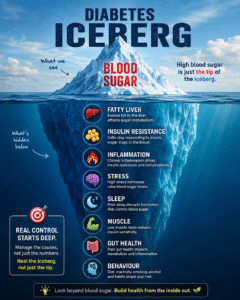
The Diabetes Iceberg
▲ VISIBLE ▲
[ Blood Sugar ]
─────────waterline─────────
▼ HIDDEN BELOW ▼
Fatty Liver · Insulin Resistance
Inflammation · Stress · Poor Sleep
Muscle Loss · Gut Health · Behaviour
[ One-Minute Action]
Take a measuring tape. Measure your waist, standing, at navel level. Write the number down — see Section 6 for what it means.
If you want to check what mistakes are you doing in your Sugar Control Journey Check Here
- The Metabolic Disease Model
[Root Cause Wheel
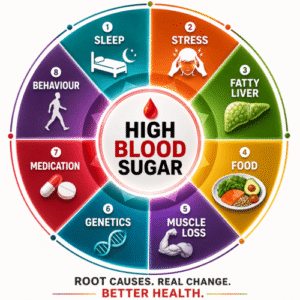
| Factor | What It Does |
| Insulin resistance | Cells stop responding efficiently to insulin’s signal to absorb glucose |
| Chronic inflammation | Worsens insulin resistance and damages blood vessels |
| Visceral & liver fat | Actively worsens metabolic control, even without visible weight gain |
| Muscle mass | Muscle is a major site of glucose disposal — low muscle mass reduces glucose clearance |
| Stress hormones (cortisol) | Raises blood glucose independent of diet |
| Sleep quality | Poor sleep measurably reduces next-day glucose tolerance |
| Food quality & timing | Determines the size and speed of glucose swings after meals |
| Genetics & age | Set baseline risk and how the body responds to the factors above |
[ Research Update]
The American Diabetes Association’s Standards of Care in Diabetes — the field’s leading evidence-based clinical guideline — is updated annually based on current scientific research and clinical trials [1], and for 2026 it raised the recommended weight-loss target in lifestyle plans to 5–7% of baseline body weight, a more aggressive target than in previous years [8]. What this means for you: even the most authoritative clinical guidelines are shifting toward more assertive metabolic (not just glucose) targets.
[✅ Top Takeaways — Section 3]
- Diabetes is metabolic, not just glucose-based
- Sugar is a downstream symptom, not the root cause
- At least 8 separate factors influence your glucose beyond diet alone
- ⚠️ The Hidden Root Causes Behind Poor Control
Root Cause Flowchart
Is your sugar not well controlled despite following your diet plan?
│
├── Sleeping less than 6–7 hours, or waking up tired? → Sleep debt
├── Sustained work/family stress? → Cortisol-driven elevation
├── Visible belly fat or a fatty liver diagnosis? → Visceral/liver fat driver
├── Meals high in refined carbs, eaten quickly, without protein/fibre? → Glycemic load driver
├── Sedentary for most of the day? → Insulin sensitivity driver
├── Missing doses or inconsistent medicine timing? → Adherence/timing driver
└── Never had detailed glucose pattern monitoring? → Unknown pattern driver
Diabetes Intelligence™
If you ticked more than one box, that’s normal — these drivers compound. Fixing diet alone while stress and sleep stay unaddressed is one of the most common reasons “I’m doing everything right but my sugar still isn’t controlled” happens.
If you want to know Stress & Sleep Connection of Diabetes watch this video-
What should I notice?
Which boxes did you tick — and which surprised you?
What should I ask my doctor?
“Given my specific pattern, which of these root causes should we prioritize first?”
- Why HbA1c Only Tells Part of the Story
| Patient | HbA1c | Pattern |
| A | 7.0% | Stable, narrow range all day |
| B | 7.0% | Frequent spikes above 250 mg/dL and dips below 70 mg/dL |
[❤️ Clinical Pearl]
Two patients, same HbA1c, completely different risk. This is why diabetes management should be individualized — variability itself is increasingly recognized as damaging, independent of the average (Section 12).
- Where Do You Stand? Reference Ranges at a Glance
[NOTE: These are commonly used general reference categories. Regional guidelines and individual targets can vary — always confirm your own targets with your doctor.]
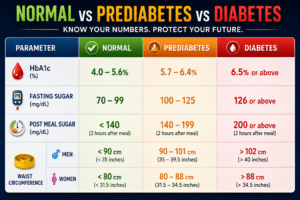
Blood Glucose
| Parameter | Normal | Prediabetes | Diabetes |
| HbA1c | Below 5.7% | 5.7% – 6.4% | 6.5% or above |
| Fasting Plasma Glucose | Below 100 mg/dL | 100 – 125 mg/dL | 126 mg/dL or above |
| 2-Hour Post-Meal / OGTT | Below 140 mg/dL | 140 – 199 mg/dL | 200 mg/dL or above |
Waist Circumference (commonly used Asian-population cutoffs)
| Lower Risk | Higher Risk | |
| Men | Below 90 cm | 90 cm or above |
| Women | Below 80 cm | 80 cm or above |
Blood Pressure
| Category | Systolic (mmHg) | Diastolic (mmHg) |
| Normal | Below 120 | Below 80 |
| Elevated | 120–129 | Below 80 |
| High (Stage 1) | 130–139 | 80–89 |
| High (Stage 2) | 140 or above | 90 or above |
Annual Screening Calendar
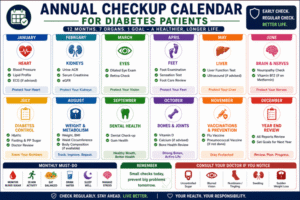
| Test | Frequency |
| HbA1c | Every 3 months |
| Urine albumin / eGFR (kidney) | Annually |
| Dilated eye exam | Annually |
| Foot sensation test | Annually |
| Lipid profile | Annually |
| Liver function / ultrasound | As advised by your doctor |
| Blood pressure | Every visit |
[ One-Minute Action]
Compare your last 3 reports against the tables above. Circle anything in the “higher risk” column — that’s your starting conversation with your doctor.
- The Silent Journey: From Prediabetes to Complications
Diabetes Transformation Journey

Diagnosis → Awareness → Assessment → Root Cause →
Action → Monitoring → Transformation → Maintenance
The Silent Journey, with intervention points marked
Prediabetes
↓ (intervention point)
Insulin Resistance
↓ (intervention point)
Diabetes
↓ (intervention point)
Silent Organ Changes
↓ (intervention point)
First Symptoms
↓ (intervention point)
Diagnosed Complications
This progression’s pace varies enormously between individuals and is influenced by genetics, weight, treatment, and lifestyle — it is not a fixed prediction. The point of the diagram isn’t the pace; it’s that every arrow is an intervention point. The earlier you act, the more of this journey is preventable or delayable.
⚕️ Doctor’s Advice
Modern diabetes care guidelines increasingly emphasize prevention and delay of complications as core treatment goals [1], alongside glucose control — not as an afterthought once complications appear.
If you want to know in Detail about Diabetes Transformation Journey Watch This Video-
- ❤️ The 7 Organ Protection Framework™

- Kidneys
- What happens: High glucose damages the small filtering vessels (nephrons) over years.
- Early warning: Usually none.
- Monitoring: Annual urine albumin-creatinine ratio, eGFR.
- Ask: “What is my current eGFR and urine albumin trend?”
- Eyes ️
- What happens: Diabetic retinopathy — damage to small retinal vessels.
- Early warning: Usually none until advanced.
- Monitoring: Annual dilated eye exam.
- Ask: “When was my last dilated eye exam?”
- If You want to know more about Diabetes and Eye Risk watch this Video-
- Heart & Blood Vessels ❤️
- What happens: Diabetes accelerates atherosclerosis; cardiovascular disease is a leading cause of death in people with diabetes.
- Monitoring: BP every visit, annual lipid profile.
- Ask: “Is my cardiovascular risk being actively assessed, not just my sugar?”
- If you want to know more about Diabetes and Cardiac Risk Watch this video-
- Nerves
- What happens: High glucose damages peripheral nerves, usually starting in the feet.
- Early warning: Tingling, numbness, burning.
- Monitoring: Annual monofilament / vibration test.
- Ask: “Can you check my foot sensation today?”
- If you want to know more about Diabetes and Nerve Damage- Watch This Video-
- Feet
- What happens: Reduced sensation + reduced blood flow = unnoticed slow-healing injuries.
- Monitoring: Daily self-inspection; annual clinical foot exam.
- Ask: “Am I low, medium, or high foot-risk?”
- Liver
- What happens: Type 2 diabetes and fatty liver disease (NAFLD) frequently co-occur and worsen each other.
- Monitoring: Liver function tests, ultrasound if indicated.
- Ask: “Should I be screened for fatty liver?”
- Brain
- What happens: Long-term poor control and recurrent low-sugar episodes are associated with increased cognitive decline risk over time.
- Monitoring: Rarely done routinely — worth raising specifically.
- Ask: “Is anything about my glucose pattern affecting my cognitive health long-term?”
- If you want to know more about Gestational Diabetes watch this Video-
[✅ Top Takeaways — Section 8]
- ✓ Every organ on this list is typically damaged silently, before symptoms
- ✓ Annual screening — not how you feel — is the reliable signal
- ✓ Bring this list’s questions to your next appointment
- DORI™ — The Diabetes Organ Risk Index
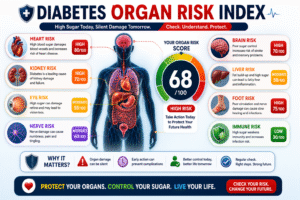
DORI™ turns seven separate screening results into one coherent risk picture. It is an educational, organizing framework — not a replacement for validated diagnostic tests or clinical judgment. Every input still comes from standard, doctor-ordered tests.
Educational DORI™ Screening Questionnaire — sample only- For Mini DORI Click Here
| Question | Response |
| Urine albumin test in the last 12 months? | Yes / No |
| Dilated eye exam in the last 12 months? | Yes / No |
| BP and lipid profile checked in the last 12 months? | Yes / No |
| Foot sensation tested in the last 12 months? | Yes / No |
| Do you inspect your own feet regularly? | Yes / No |
| Liver ever screened? | Yes / No |
| Ever had detailed glucose pattern monitoring? | Yes / No |
Each “No” is a screening gap. This starts a conversation with your doctor — it doesn’t generate a diagnosis on its own.
- The REST Method™
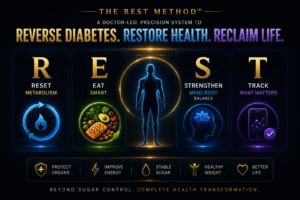
- R — Reset Metabolism: Address visceral fat, liver fat, inflammation. Today’s action: check waist circumference (Section 6).
- E — Eat Smart: See Food Swap Intelligence™ (Section 11).
- S — Stress + Sleep: Treat both as clinical levers. Today’s action: fix one consistent sleep/wake time this week.
- T — Test + Track: DORI™ screening plus, where useful, CGM pattern data.
[⚕️ Doctor’s Advice]
REST™ does not replace medical treatment. It organizes medication, food, movement, sleep, and organ screening into one connected system.
- Food Swap Intelligence™
Breakfast
| Instead of | Try | Why It Helps |
| White poha / plain upma | Poha/upma + peanuts, vegetables, boiled egg or paneer | Adds protein & fibre |
| Sweetened tea + biscuits | Unsweetened tea/coffee + roasted chana or nuts | Removes a fast sugar hit |
| Maida paratha | Multigrain or besan chilla | Lower glycemic load |
Lunch / Dinner
| Instead of | Try | Why It Helps |
| White rice first, large portion | Vegetables + dal/protein first, smaller rice last | Blunts the glucose spike |
| Deep-fried sabzi | Sautéed/steamed sabzi | Reduces fat-sugar load |
| Sweet lassi/soft drink | Buttermilk or water | Removes a large fast sugar load |
Snacks
| Instead of | Try | Why It Helps |
| Samosa/pakora | Roasted makhana, sprouts chaat, roasted chana | Lower refined-carb/fat load |
| Packaged biscuits | Nuts + fruit | Adds fibre and healthy fat |
Festivals & Eating Out
| Situation | Swap |
| Wedding buffet | Vegetables/protein first, one sweet, small portion |
| Diwali sweets | One favourite, small piece, walk afterward |
| Office lunch | Extra vegetables/dal, smaller rice/naan portion |
| Street food | Grilled/roasted over deep-fried where possible |
[⚠️ Common Mistake]
Total avoidance backfires into bingeing later. This is about composition and portion, not elimination.
- CGM Precision Intelligence™
A continuous glucose monitor shows glucose every few minutes, for days or weeks — turning “avoid rice” into “here’s what your plate of rice actually does to your glucose.”
Illustrative example (not a universal result): a patient sees a large post-lunch spike, tests a smaller portion + a 10-minute walk afterward, and sees a visibly flatter curve on the same meal.
[ Research Update]
The ADA’s 2026 Standards of Care state that CGM benefits have been shown regardless of age, sex, education, income, or baseline diabetes characteristics [2], and the 2026 update expanded recommendations for CGM and automated insulin delivery technology more broadly [1]. What this means for you: CGM is increasingly positioned as broadly useful, not a niche or “advanced-case-only” tool — worth asking your doctor if it fits your stage of care.
- Behaviour Intelligence™
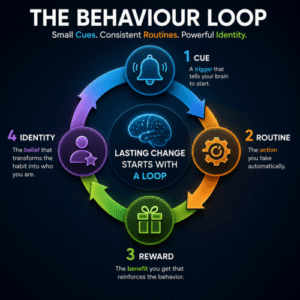
Behaviour Loop in Diabetes
- Trigger mapping: What precedes the unwanted habit? (e.g., evening stress → sugary snack)
- Environment design: Is the healthier option actually convenient in that moment?
- Habit stacking: Attach new habits to existing ones
- Identity framing: “I protect my kidneys and eyes” sustains longer than restriction-only framing
- Relapse planning: Expect slips; have a specific “return to routine” plan
[ Quote Card]
“Treat numbers. Or understand people.”
- ⚖️ Traditional Approach vs. Diabetes Intelligence™ Approach
| Traditional Approach | Diabetes Intelligence™ Approach |
| Treat the sugar number | Understand the underlying metabolism |
| One diet plan for everyone | Personalized, culturally realistic nutrition |
| HbA1c as the main indicator | Multiple indicators, including organ risk |
| Annual or quarterly review | Continuous, structured tracking |
| React after complications appear | Screen and act before symptoms appear |
- ❓ Myth vs. Fact
| Myth | Fact |
| “If my sugar report is normal, my organs are safe.” | HbA1c doesn’t measure kidney, eye, nerve, or liver risk. |
| “Diabetes is caused by eating too much sugar.” | Insulin resistance, genetics, visceral fat, sleep, and inflammation all contribute. |
| “I’ll know if my kidneys/eyes are affected because I’ll feel it.” | Early damage is usually symptom-free. |
| “Fruit is dangerous for diabetics.” | Whole fruit in reasonable portion is generally fine; fruit juice is the bigger concern. |
| “Once you’re on insulin, it means things have failed.” | Insulin is a treatment tool at different disease stages, not a personal failure marker. |
| “Stress doesn’t really affect blood sugar.” | Cortisol directly raises glucose and reduces insulin sensitivity. |
| “Diabetics can never eat sweets again.” | Portion-controlled, occasional inclusion tends to be more sustainable than total elimination. |
| “Ayurvedic/herbal products can replace my medicines.” | Never replace prescribed medication without your doctor’s involvement. |
| “Diabetes only affects older people.” | Type 2 diabetes is increasingly diagnosed in younger adults, as Priya’s story shows. |
| “If I feel fine, I don’t need my quarterly checkup.” | Complications are typically silent until advanced. |
| “Walking doesn’t matter as much as diet.” | Short post-meal walks measurably reduce glucose spikes independent of diet. |
| “CGM is only for type 1 diabetes or serious cases.” | CGM use in type 2 diabetes has grown for its personalized pattern insight. |
If you want to know more about Diabetes Reversal & its possibility- Watch this video-
- ✅ The 30-Day Diabetes Reset Checklist
Week 1 — Awareness
- [ ] Plot your last 3 HbA1c results — look at the trend
- [ ] Complete the DORI™ questionnaire (Section 9) and note your gaps
- [ ] Track sleep timing for 7 days without changing anything yet
Week 2 — Nutrition
- [ ] Apply one Food Swap to your most common breakfast
- [ ] Practice vegetable/protein-first sequencing at one meal a day
- [ ] Replace one sugar-sweetened drink a day with water or buttermilk
Week 3 — Movement & Stress
- [ ] Add a 10-minute walk after your largest meal
- [ ] Add one 5-minute wind-down practice daily
- [ ] Set a consistent sleep and wake time
Week 4 — Screening & Follow-Up
- [ ] Book any overdue screening from your DORI™ gap list
- [ ] Prepare your Doctor Visit Checklist (Section 17)
- [ ] Review what changed — energy, cravings, sleep, mood — not just glucose
- ⚕️ Your Next Doctor Visit — What to Ask
- What is my current eGFR and urine albumin trend over the last 2 years?
- When was my last dilated eye exam?
- Can we check my foot sensation today?
- Should I be screened for fatty liver?
- Is my current medication timing optimal for my glucose pattern?
- Would CGM be useful for me at this stage?
- Which of the 7 organ systems carries the most risk for me personally?
- Frequently Asked Questions
Q1. Is type 2 diabetes reversible? For some people — particularly those diagnosed relatively recently who make sustained changes to weight, nutrition, and activity — significant improvement is possible, sometimes to medication-free normal glucose levels. This varies by individual and should be assessed with your doctor.
Q2. My HbA1c is normal — are my organs automatically safe? No. HbA1c reflects average glucose, not organ-specific risk. Kidney, eye, nerve, and cardiovascular screening should happen on their own schedule.
Q3. How often should I get kidney, eye, and nerve screening done? General guidance is annual, though your doctor may recommend a different frequency based on your risk.
Q4. Does stress actually raise blood sugar? Yes — chronic stress raises cortisol, which increases liver glucose output and reduces insulin sensitivity.
Q5. Is CGM necessary, or only for type 1 diabetes? Its use in type 2 diabetes has grown significantly for the personalized insight it offers — see Section 12.
Q6. What’s the single most important lifestyle change? There isn’t one — it depends on which root cause (Section 4) is most active for you.
Q7. Can diabetes affect the brain? Yes — long-term poor control and recurrent low-sugar episodes are both associated with increased cognitive decline risk.
Q8. Can I eat rice/roti at all? Most patients can, in appropriate portion and sequence — see Section 11.
Q9. What is “time in range”? The percentage of the day your glucose stays within a target range set with your doctor — more detailed than a single HbA1c number.
Q10. Is diabetes hereditary? Family history raises risk, but lifestyle and metabolic factors strongly influence whether and when it develops.
Q11. Do I need to avoid all fruit? No — whole fruit in reasonable portion is generally fine; fruit juice is the bigger concern.
Q12. How is prediabetes different from diabetes? See the reference ranges in Section 6 — prediabetes is a critical window for prevention.
Q13. Can young, non-overweight people get type 2 diabetes? Yes — visceral/liver fat, genetics, and lifestyle can contribute independent of overall body size, as with Priya.
Q14. Why did my doctor add a second medicine even though I’m “following the diet”? Diabetes is progressive; beta-cell function can decline over time regardless of adherence.
Q15. What should I do if my feet feel numb or tingly? Get it checked promptly — an early sign of possible nerve involvement.
Q16. Are herbal or Ayurvedic remedies safe to combine with my diabetes medicine? Always discuss with your doctor first — interactions are possible.
Q17. How does sleep actually affect blood sugar? Poor sleep measurably reduces insulin sensitivity the next day.
Q18. What is glucose variability? How much your glucose swings, not just its average — increasingly linked to vascular stress independent of the average.
Q19. Can diabetes be managed without medication? For some with prediabetes or early type 2 diabetes, lifestyle alone may suffice — an individual decision with your doctor.
Q20. What is the DORI™ score, and can I calculate it myself? It organizes results from doctor-ordered tests into one picture — the inputs need to come from your doctor, not a self-test.
- References
A working reference set, built from real, current sources rather than a padded citation list. Expand with peer-reviewed studies and ICMR-INDIAB data as needed before publication.
- American Diabetes Association. Standards of Care in Diabetes — 2026. Diabetes Care, 2026. professional.diabetes.org/standards-of-care
- American Academy of Family Physicians. CGM: ADA 2026 Standards of Care. aafp.org
- International Diabetes Federation. IDF Diabetes Atlas, 11th Edition (2025). diabetesatlas.org
- Genitsaridi I, et al. 11th edition of the IDF Diabetes Atlas: global, regional, and national diabetes prevalence estimates for 2024 and projections for 2050. Lancet Diabetes & Endocrinology, 2026.
- Not one-size-fits-all: diabetes in south Asia. Lancet Regional Health – Southeast Asia, 2025. (PMC)
- World Health Organization. Diabetes Fact Sheet. who.int (link to be verified/updated at publish time)
- Indian Council of Medical Research — INDIAB Study. (India-specific epidemiological data — recommend direct citation once specific figures are pulled)
- DiabetesontheNet. The 2026 ADA Standards of Care: What’s new? diabetesonthenet.com
Note on citation practice: claims in this article that come from search-verified sources above are marked accordingly; general physiological explanations (e.g., how insulin resistance develops) reflect well-established, textbook-level clinical consensus rather than a single citable study, and are presented as such rather than attributed to a specific paper.
Expert Review Panel
Medically Reviewed By: Dr. D.K. Rai, MBBS, MD, CDM(Diabetes) Evidence Reviewed: 01-08-2026 Version: v4 Next Review Date: 01-08-2027
- Continue Your Diabetes Intelligence™ Journey
Join The India’s Diabetes Healing Hub Free Whatsapp Community in Make India Diabetes Free Mission by Dr D K Rai
Regular research, nutrition, organ protection, and food intelligence — straight from Dr. D.K. Rai’s practice. Join Here
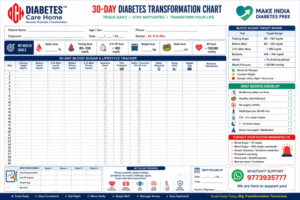
Use this 30 days Diabetes Transformation Chart & see the result & share this Diabetes Guide to Diabetic Friends & Family members and become the Make India Diabetes Free Ambassador to reduce burden of Diabetes in next generation of India
Start With Understanding Your Own Diabetes
If you’d like a structured understanding of your own situation, explore a personalized assessment that may include:
✓ Root Cause Review · ✓ Diabetes Organ Risk Discussion · ✓ Lifestyle Review · ✓ Behaviour Intelligence™ · ✓ Food Pattern Review · ✓ CGM Data based Precise Plan · ✓ Personalized Action Plan
Comment REST” or call 9773935777 or Visit Diabetes Care Home, Plot no 30, Shakti Khand 4, Indirapuram, Ghaziabad, UP with prior appointment
For More Diabetes Education and research Updates Follow us on
Related reading:
- The 7 Hidden Drivers of High Blood Sugar
- Why HbA1c Alone Doesn’t Tell the Whole Story
- The 7 Organ Protection Framework™, Explained
- Understanding Fatty Liver in Diabetes
- CGM Precision Intelligence™: A Practical Guide
- Food Swap Intelligence™: The Full Meal Library
- Tracking Your Progress Over Time
- The Gut Microbiome & its role in Diabetes Reversal: Emerging Research & Practical Tips

